

October 2026
Our Secretary General attended and presented at the two-day World Heritage UK Annual Conference, “Connections through World Heritage”.
The conference was held on the Causeway Coast, Northern Ireland’s first UNESCO World Heritage Site. The conference coincided with the Giant’s Causeway’s 40th anniversary as a World Heritage Site, along with the other six Sites that were the first wave of UK Sites to be inscribed back in November 1986.
Chiara Ronchini was one of the speakers at the conference on Tuesday 6th October, alongside other heritage professionals, including the International National Trust Organisation, the European Network of World Heritage Associations, Ireland’s National Monument Service, Frontiers of the Roman Empire and many more. Delegates also went on site visits to the Giant’s Causeway and Gracehill Moravian Church Settlements World Heritage Sites.
Reflections from our Secretary General
🤝 Working together
- Collaboration has now joined the five Cs as the sixth, which was the theme of her talk, “The Sixth C: Collaboration Beyond Borders”. Transnational properties such as The Great Spa Towns of Europe, the Frontiers of the Roman Empire and The Moravian Church Settlements show it working in practice.
- The networks are often already there. Shared interest often comes before designation. The Limes Congress has connected Roman frontier specialists since 1949. Similarly, the European Institute of Cultural Routes, Cultural Routes of the Council of Europe Programme overlap with many World Heritage Sites, including The Great Spa Towns of Europe.
- Scale needs structure: manageable sections, consistent governance and coordination at both central level and local level. For example, local steering groups can be included in management, ensuring communities and local authorities have a stronger voice.
🌍 People
- Interpretation of World Heritage should be shaped with communities rather than for them. It should be centred around their own values. The Dacian Limes framework and Sligo’s meitheal are good examples.
- Participation does not automatically lead to influence. That takes trust, understanding and the right structures, and change moves at the speed of trust. As Paulo Freire reminded us via one speaker, programmes that ignore how people see their own world risk becoming cultural invasion. We are merely custodians of our places. The work has to happen with our communities and young people.
💶 Resources
- Funding is more competitive than ever: we now compete not only with each other, but with apps, algorithms and AI. Yet investment is not only financial. Anything that improves our heritage places brings a return, for communities as much as for the sites.
- Working internationally is not a holiday! It opens minds, helps us see our own places differently, builds resilience and reminds us we are part of something bigger.
🌞 Highlights
The Giant’s Causeway was seen at its most atmospheric in rain, wind and sea spray. “This pile o’ stanes” still captivates visitors, and the coins pressed between the columns over the years, now being removed, show the management challenges of popularity. Wishes can indeed have a conservation cost. The visitor centre, new to me since my last visit around 2009, blends in very well in its heritage landscape.
Gracehill, one of four components of the serial transnational Moravian Church Settlements, is still a living community of practice, and an early example of Irish urban planning, which kept the urbanist in me very happy. We even had tea and cake with the Mayor!
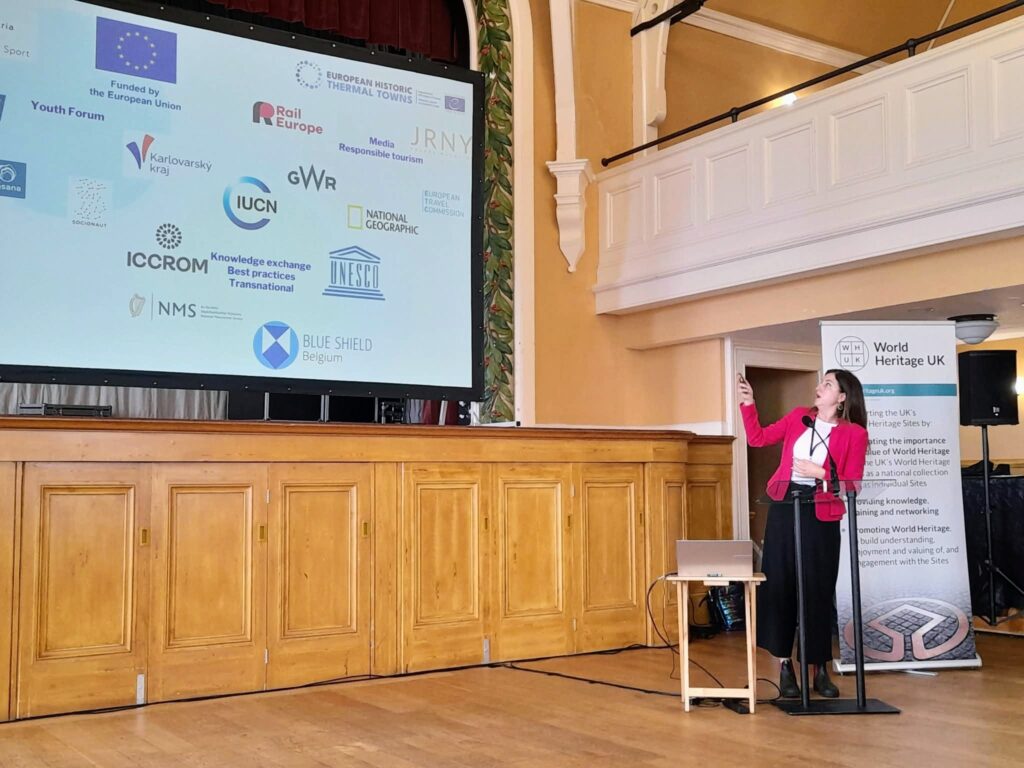
Chiara Ronchini presents recent projects at the World Heritage UK Annual Conference. ©Chiara Ronchini.