

January 2026
On 21st January 2026, the Secretary General of The Great Spa Towns of Europe joined a national conference in Rome about spa tourism: “Italian Thermal Tourism as a Driver of Market Growth”. The conference was organised by ISNART (The Chambers of Commerce for Tourism and Culture) and held at Unioncamere, Piazza Sallustio.
Management Practices and Experiences to Strengthen Spa Destinations
The panel discussion was entitled “Good Management Practices and Relaunch Experiences to Strengthen the Attractiveness of Spa Destinations in a European Benchmarking Logic”. The Secretary General, Chiara Ronchini, was joined by two other spokespeople from The Great Spa Towns of Europe – Klaus Lorenz, Director of Tourism for Baden bei Wien, Austria; and Yves-Jean Bignon, Deputy Mayor of Vichy, France, and the Vice-President of The Great Spa Towns of Europe Association. These two experts gave detailed insights and guidance from their towns, including the integrated promotional action used in Baden bei Wien, health and wellness tourism, the evolution of the spa product and hotel facilities as well as a case study on Vichy. Emanuele Boaretto, President of Federalberghi Terme, was also part of this panel discussion. The entire conference was moderated by Francesca Alliata Bronner, a journalist at La Repubblica, and introductory remarks were given by Andrea Prete, President of Unioncamere, and Loretta Credaro, President of ISNART.
The final report from the conference is now available to the public to access via ISNART’s website: https://www.isnart.it/it/news/il-rilancio-del-turismo-termale-italiano/; or available directly at https://www.isnart.it/wp-content/uploads/2026/01/Abstract-Rapporto-Termale-2026.pdf as a downloadable PDF.
Transformation: European Thermalism is Experiencing a New Phase
Chapter 5 of the report presents expertise from The Great Spa Towns of Europe, with case studies from Bath, UK, and Vichy, France. The spa in Budapest is also included, but this is not one of The Great Spa Towns of Europe. These international success stories review thermalism in Europe and the return of wellness as an integrated, sustainable and evidence-based model.
As Chiara Ronchini, Secretary General of The Great Spa Towns of Europe World Heritage Site, explains:
“Historic spa towns have never been merely places of treatment: they have been—and remain—spaces where care for the body intertwines with culture, the environment and social life.
Today, European thermalism is experiencing a new phase: no longer limited to balneological therapy or medical rehabilitation, but rather an integrated offer known as thermal wellness—a holistic experience combining preventive health, outdoor activities, cultural offerings, and personalized services.”
Several factors have driven this transformation, particularly a growing global demand for health-orientated experiences. More attention is given to sustainability, more scientific research is applied to preventative healthcare and younger travellers have an increased desire for authentic experiences.
Industry reports also illustrate that wellness is increasingly understood as a lifestyle rather than an occasional activity.
Integrating Culture, Sports and ‘the Spa Town Way of Life’
The Great Spa Towns of Europe (a transnational serial site inscribed on the UNESCO World Heritage List in 2021) is a valuable example. This series of eleven towns developed around natural mineral springs that created a social culture linked to water.
Cultural venues, public spaces, walkable urban areas, parks, spa institutions and carefully preserved urban fabrics are still present in these spa towns, meaning the management practices that support a ‘spa town way of life’ for tourists and residents can serve as examples for other European spa destinations.
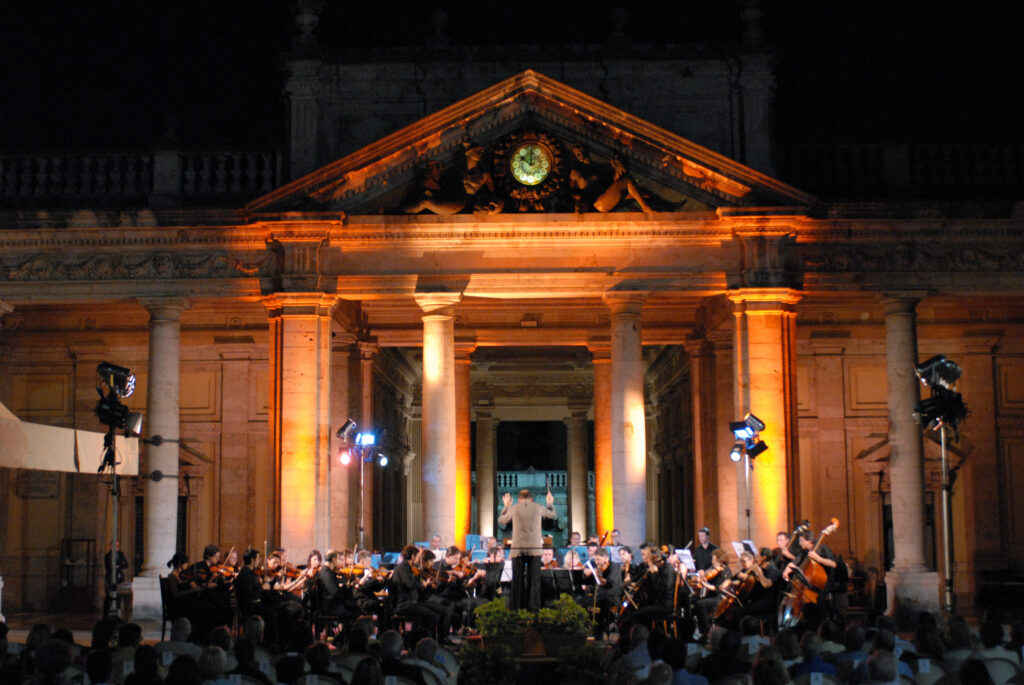
The Estate Regina Orchestra, Montecatini Terme, Italy. A concert in a spa building shows modern culture, heritage and the spa offering intertwined.
There are three central elements for the development of thermal tourism today:
1. Scientific evidence
2. Environmental sustainability
3. Personalised offers
This modern experience of thermalism is already operating on the ground in 2026. Redevelopment projects (such as new urban spas that integrate contemporary architecture with heritage), customised health programmes and enhanced sporting and cultural events that amplify the social role of the spa towns.
In the City of Bath, UK, one of The Great Spa Towns of Europe, the reopening of Thermae Bath Spa was a prime example of modernising the thermal and spa offering of the town without compromising its historical layers or erasing any part of European spa culture.
This new concept of European thermalism is becoming a model of sustainable development for spa destinations, integrating:
– Preventative health and evidence-based treatments
– Experiential tourism with authentic, local experiences
– Cultural heritage protected and used as intertwined with the spa
– Green strategies and soft mobility that creates walkable spa landscapes
The Great Spa Towns of Europe embody many of these and can be useful case studies for European spa destinations. Some replicable principles include: governance that combines heritage and promotion, tourism products that go beyond single treatments to healthy lifestyles, alongside public-private mixes for redevelopment.
The aim is to transform thermalism into a central element of a wellness-offering closely connected to its local area. Integrated with the region, it offers a capable way of generating social, cultural and economic value for local communities.
For more information and a closer look at the case studies, please see the final report from the conference, which is now available to the public to access via ISNART’s website: https://www.isnart.it/it/news/il-rilancio-del-turismo-termale-italiano/; or available directly at https://www.isnart.it/wp-content/uploads/2026/01/Abstract-Rapporto-Termale-2026.pdf as a downloadable PDF.
The Great Spa Towns of Europe
The Great Spa Towns of Europe is a serial, transnational UNESCO World Heritage Site comprised of eleven spa towns across seven European countries. Together, these towns comprise one ‘property’ .
From the hundreds of spa towns across Europe, these eleven are the most authentic examples of the European spa phenomenon. As epicentres for social, cultural and political innovations, these spa towns shaped architecture, urban design, medicine, health and wellness tourism and modern European identity.
The site was inscribed on the UNESCO World Heritage List on 24th July 2021; the highest international recognition for global cultural and natural heritage sites. The Site is managed by The Great Spa Towns of Europe Association, formally registered in August 2022 in Baden bei Wien, Austria.