

March 2026
2026 marks five years since The Great Spa Towns of Europe (the GSTE) was inscribed as a UNESCO World Heritage Site on 24th July 2021, albeit as a very complex one. Rather than a single location, it is a serial, transnational World Heritage Site, formed of eleven historic spa towns from seven countries across Europe.
The inscription changed the way these spa towns operate, ensuring they are preserved for future generations with authenticity and integrity. The unique cultural heritage, traditions and spa town way of life are protected as an invaluable branch of European history, that shaped health, science, the arts, architecture and society across Europe and pioneered health and wellness tourism.
Out of the hundreds of spa towns across Europe, the eleven in the GSTE are the most representative of the European spa culture that emerged from the 18th – early 20th centuries.
1. Baden bei Wien, Austria. | The Spa of Emperors
2. Spa, Belgium. | The Cafe of Europe
3. Františkovy Lázně, Czech Republic. | A European Model Spa
4. Mariánské Lázně, Czech Republic. | Grand Harmony with Nature
5. Karlovy Vary, Czech Republic. | Europe’s Open-air Salon
6. Vichy, France. | Queen of the Spa Towns
7. Bad Ems, Germany. | The Picturesque Imperial Spa
8. Baden-Baden, Germany. | Summer Capital of Europe
9. Bad Kissingen, Germany. | Between Classicism and Modernity
10. Montecatini Terme, Italy. | Garden Spa of Europe
11. City of Bath, UK. | Georgian Spa City
Celebrations Across Europe
Major anniversaries are also running in individual towns in 2026, including 100 years of the Art Deco Thermalstrandbad Lido in Baden bei Wien, 20 years of Thermae Bath Spa in Bath — the UK’s only thermal waters — and 235 years since The Women’s Revolt in Františkovy Lázně, a women’s protest that founded the spa town.
Vichy, France, runs spectacular birthday festivities every July. To honour the anniversary, special events are planned across Europe, raising awareness of the heritage attributes of the Great Spa Towns and celebrating shared European spa heritage. A full list of celebrations is linked here.
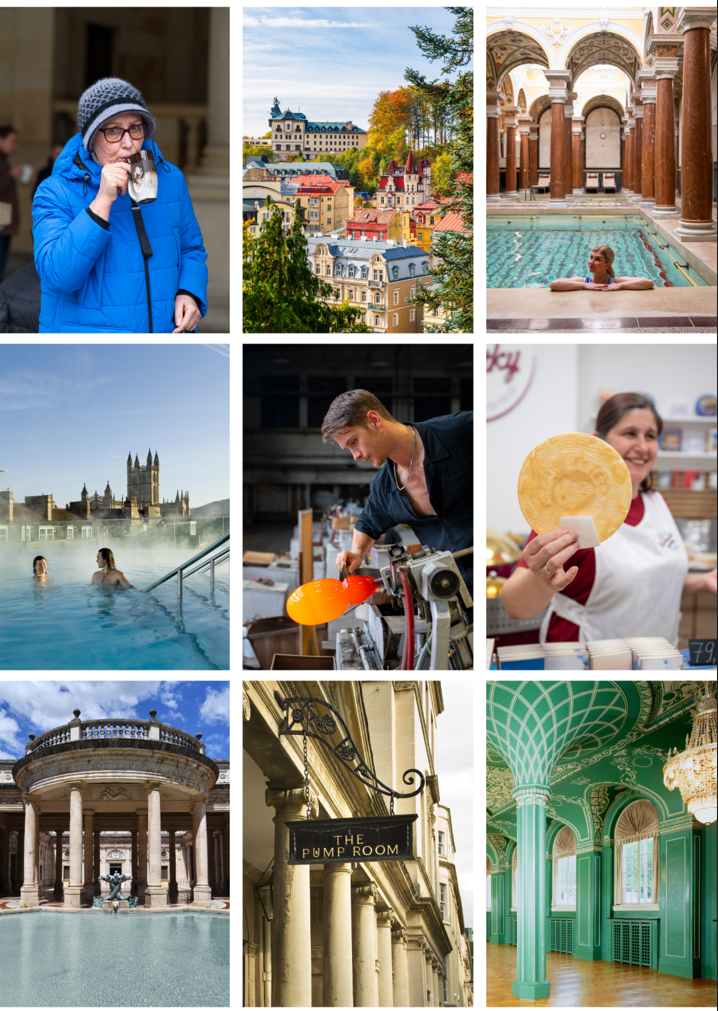
Images of The Great Spa Towns of Europe. Images courtesy of The Great Spa Towns of Europe. (c) Jordan Banks, JRNY Magazine. (c) Visit West. (c) Bad Kissingen. (c) Montecatini Terme.
The UNESCO Inscription
The UNESCO inscription established a classification of ‘heritage assets’ that collectively give the property its ‘Outstanding Universal Value’. These defining elements – from spa architecture and therapeutic landscapes to natural springs and the continuing spa function – unite the GSTE towns as an integrated whole. While each town contributes its unique character, they must be protected as one cohesive heritage.
This shared responsibility created a governance structure that operates alongside local and national legislation. The framework has strengthened international cooperation, conservation efforts and allowed the towns to collaborate on projects, such as promoting responsible tourism, empowering local communities and getting the next generation involved in the future of their spa towns.
Chiara Ronchini, Secretary General of The Great Spa Towns of Europe, said:
“It has been an honour to lead the GSTE through this transformative period. Building on our spa towns’ tradition of bringing people together, we practise what I call ‘heritage diplomacy’, where decisions are grounded in consensus and participation.
The GSTE Youth Forum, created through the EU-funded INTERSPACE project, is an example of this heritage diplomacy in action. Inclusive and participatory, it gives young people a voice in our governance and embodies the peace-building mission at the heart of UNESCO World Heritage. I look forward to deepening this collaborative spirit through many more joint initiatives in the years ahead.”
Becoming a serial, transnational grouping has also provided the GSTE with unique opportunities. In 2025, four experts from the Association enrolled on a three-year training course with Preserving Legacies, a global climate adaptation programme for heritage sites funded by the National Geographic Society. It equips heritage managers with the skills to adapt to climate change. For Preserving Legacies, working with the GSTE was a significant step forward, as its international, interconnected structure allows these new learnings to be amplified across the network at scale.
Oliver Krügel, Chair of The Great Spa Towns of Europe and Mayor of Bad Ems, Germany, added:
“Over the past five years, the UNESCO inscription has created a robust international friendship between our spa towns. Our shared spa heritage has connected us for centuries, but today, it is cause for mutual celebrations as well as genuine professional support.
Our young people are now involved in the governance of The Great Spa Towns of Europe and, over the next five years, I look forward to seeing how their contributions shape our towns, for residents, tourists, history lovers, spa aficionados and anyone else who would like to experience the Great Spa Town way of life.”
The UNESCO status has helped to raise global awareness of the cultural, architectural, medical and therapeutic legacy of European spa traditions. These towns were the first examples of towns built around a medical practice, pioneering innovative approaches to health and wellbeing, influencing urban planning, medical science, leisure culture, architecture and social life well beyond Europe.
As the world continues to place greater emphasis on health and wellbeing, The Great Spa Towns of Europe remains a long-standing European tradition rooted in healing, resting, social exchange and a respect for the Earth’s natural resources.
World Heritage Sites are considered to have “cultural and/or natural significance which is so exceptional as to transcend national boundaries” and belong to all humankind. Beyond uniting the spa towns themselves, the work of protecting a UNESCO site for the good of humanity embodies UNESCO’s original founding values; creating peace through cooperation between nations. As spa towns connected people in the past, being safe environments where different peoples could come together, the work of the GSTE today is to continue to cultivate kinship, mutual respect and peace.
The Great Spa Towns of Europe
The Great Spa Towns of Europe is a serial, transnational UNESCO World Heritage Site comprised of eleven spa towns across seven European countries. Together, these towns comprise one ‘property’ .
From the hundreds of spa towns across Europe, these eleven are the most authentic examples of the European spa phenomenon. As epicentres for social, cultural and political innovations, these spa towns shaped architecture, urban design, medicine, health and wellness tourism and modern European identity.
The site was inscribed on the UNESCO World Heritage List on 24th July 2021; the highest international recognition for global cultural and natural heritage sites. The Site is managed by The Great Spa Towns of Europe Association, formally registered in August 2022 in Baden bei Wien, Austria.