

October 2026
Conference on Thermal Systems and Spa Towns: Geological, Hydrogeological and Geochemical Frameworks, Conservation, Research and Future Perspectives
The springs of mineral and thermal water that formed naturally in The Great Spa Towns of Europe are at the heart of the UNESCO World Heritage Site. These curative waters were the start of the 18th-20th century European spa phenomenon, the basis of our UNESCO inscription, as well as the core of many earlier traditions.
This is why they are key to understand and protect. The other aspects of the Property (including spa architecture, spa urban design, the spa landscape and cultural traditions) are well understood, documented and managed. Studying our springs helps our experts understand them more deeply, protect them from the impacts of climate change and assessing future risks.
An international conference dedicated to the geology, hydrogeology, geochemistry, medical use and sustainable management of thermal and mineral water systems within the UNESCO World Heritage Site ran from 9–10 October 2026 in Montecatini Terme, Italy. The conference was organised by the University of Florence and hosted by the Municipality of Montecatini Terme.
An opportunity for scientific exchange and collaboration
Each member town in The Great Spa Towns of Europe was invited to send an expert representative, working across hydrogeology, geology, the medical use of mineral water, thermal water management and protection.
The group presented the management systems of each town, discussing the geological, hydrogeological and geochemical status of thermal systems. Experts discussed the different methodologies used for monitoring water systems, identifying the challenges and best practices of different approaches.
It was important to examine the regulatory frameworks at both a national and regional level, as well as to discuss the multiple beneficial uses of thermal waters in different contexts.
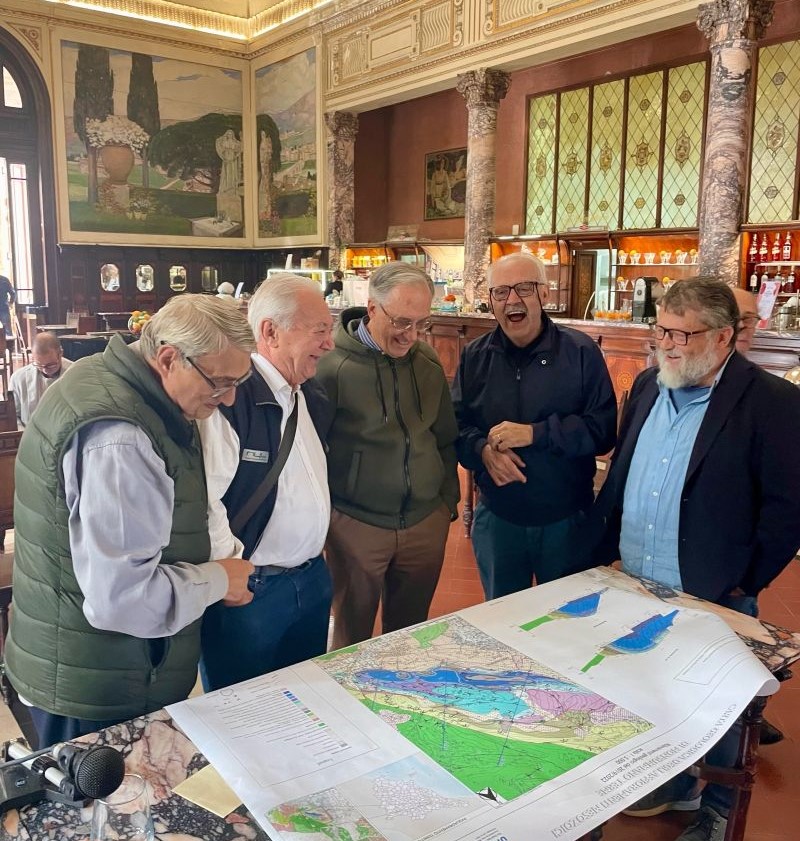
Hydrogeology group study a map. Image courtesy of Chiara Ronchini.
Climate change
The impact of climate change is a priority for The Great Spa Towns of Europe. Four representatives from the association have been working with Preserving Legacies, a programme to develop the skills and knowledge to adapt to climate change in World Heritage Sites. Naturally, the impacts of climate change on hydrogeological systems was a key topic during the conference. The conference helped to build a foundation for future research and adaptive management strategies that respond to evolving
environmental conditions.

Board shows the work of the hydrogeology conference. Image courtesy of Chiara Ronchini.
Establishing collaborative guidelines
The conference resulted in specialist technical working groups being established, involving representatives from each town in The Great Spa Towns of Europe. The group also developed common guidelines for conservation and agreed on the next steps, ensuring future work is aligned across the network.
The conference was an excellent opportunity for in-depth discussions and for participants to exchange knowledge, experience and expertise. As a serial, transnational World Heritage Site, the 11 towns work together on shared goals, which is a benefit of an international network.
-

- Group outside in Montecatini Terme at the Geological, Hydrogeological and Geochemical Conference. Photo courtesy of Chiara Ronchini.

-

- Group at the Geological, Hydrogeological and Geochemical Conference. Photo courtesy of Chiara Ronchi.
