

Roman Origins
Baden-Baden was founded by the Romans at the location of a former Celtic settlement. It was named ‘Citavis Aurelia Aquensis’ (the city of Aurelia of the waters) in honour of Aurelius Severus and Baden-Baden’s hot springs. Roman garrisons were stationed here from the second century BC onwards, using the healing waters, above all, to cure war injuries. But the baths were also an important meeting place for relaxation and socialising, and luxury baths were built for emperors, soldiers and horses. Remains of the soldiers’ baths with sophisticated heating and water technology are still located below the Friedrichsbad.
Middle Ages
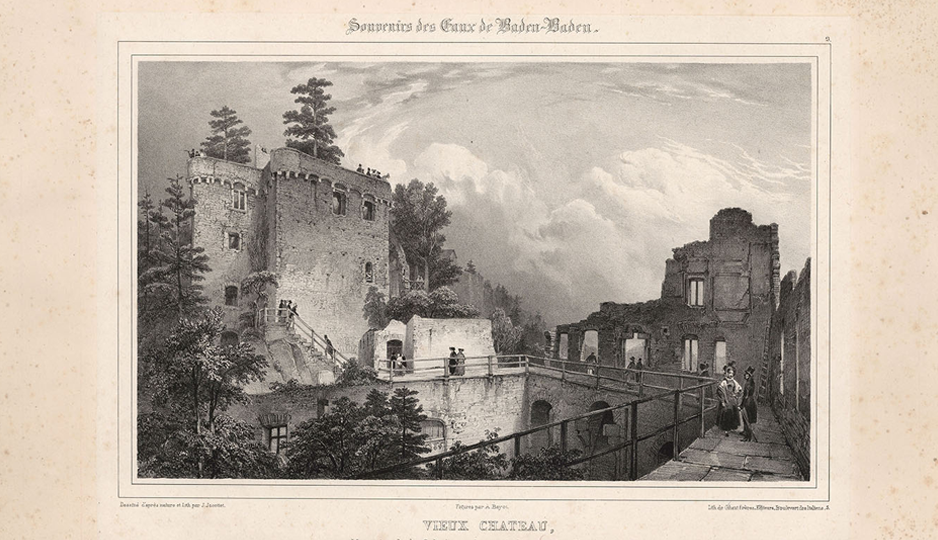
In the Middle Ages, rheumatic complaints and injuries continued to be treated by bathing in the thermal waters. In 1112, Baden-Baden and the newly constructed Hohenbaden Castle served as the seat of the Margraves of Baden. The Lichtenthal Convent was founded in 1254. In the 14th century, the town was successfully flooded several times with thermal water as protection against epidemics.

Early Modern Period
Until the Thirty Years’ War (1618-48), Baden-Baden flourished as a bathing town. Around the mid-17th century, the richly stuccoed princely bath was built at the orders of Margrave Ferdinand Maximilian (1652-69) on the ground floor of the New Palace on Florentine Hill. In 1689, during the War of the Palatinate Succession (1688-1697) between France and the “Holy Roman Empire”, Baden-Baden was burned to the ground by the French.

Age of Enlightenment
Baden-Baden’s resurgence as a spa town was initiated with the building of the Promenade House and the laying out of a chestnut lined avenue outside the city walls and west of the Oos River in 1765-66. This marked the beginning of a new spa quarter, which was not only soon to outstrip the spa quarter in the old town, but was also to lead to a shift in the focus of the city’s structural, economic and social development.

Summer Capital of Europe
From the dawn of the 19th century, the town was systematically transformed into a modern health resort. The old city gates and the city walls were demolished, and the town spread further into the Oos Valley and the surrounding landscape. The Promenade House was converted into the Konversationshaus (today’s Kurhaus) by Friedrich Weinbrenner, the Grand Duke of Baden’s building director, from 1821-24, and the Trinkhalle was built by Heinrich Hübsch from 1839-42.

Summer Capital of Europe-II
The Franco-Prussian War (1870-71) and the ban on gambling in the German Empire in 1872 had a noticeable impact Baden-Baden’s development. However, the city responded to this by returning to its centuries-old bathing tradition. The Friedrichsbad was built between 1869 and 1877, directly next to the thermal springs in the old spa quarter. The monumental bathing temple met the most modern demands and was considered the most modern bathhouse in Europe when it opened.